Corporate Gifting ROI: how to measure the impact [Framework]
January 21, 2026 · Gifting, Culture
Calculate your corporate gifting ROI with our step-by-step framework. Measure employee retention, engagement impact, and prove program value to leadership.
Quick answer: Corporate gifting ROI is rarely a single figure - it is usually a mix of retention, engagement, referrals, and manager adoption. Start with metrics you can defend in finance: gifts sent, recipients reached, cost per recognition moment, and (where possible) participation or pulse scores for cohorts that received gifts.
Let's be honest: "It boosts morale" isn't going to cut it with your CFO.
When you graduate from pilots to always-on budgets, Huggg plans for distributed teams surface adoption and spend data your CFO can track. Keep customer thank-yous on a client gifting platform so ROI reviews do not mix pipeline gifts with people spend.
You know corporate gifting works. You've seen the smiles when people receive gifts, heard the thank yous, felt the warm glow of making someone’s Monday less miserable. But when it's budget review time and finance asks "What's the ROI?", “people seem happier" doesn't exactly make it into the spreadsheet.
Corporate gifting absolutely has measurable ROI. Employee retention. Engagement scores. Client lifetime value. It's all trackable. The problem? Most companies don't know how to measure it.
That changes today.
This guide gives you a complete framework for calculating corporate gifting ROI - the kind you can actually present to leadership. We're talking hard numbers, not fuzzy feelings.
Want the numbers for your company first? Our interactive ROI calculator runs the full model in about three minutes - same logic as the framework below, turned into a tool you can send to your CFO. Calculate your ROI →
Let's dig in.
Why ROI measurement matters (and why most people skip it)
The CFO problem
Your finance team doesn't care about "employee happiness." They care about:
- Cost per employee retained
- Productivity per pound spent
- Client lifetime value
- Revenue per recognition touchpoint
That's not them being cold. That's them doing their job.
And if you can't speak their language, your gifting budget gets cut. Simple as that.
Why most gifting programmes don't measure ROI
We've talked to hundreds of People teams. Here's what we hear:
- "We don't have time to track it"
- "It's too complicated to measure"
- "We just know it works"
- "HR isn't data-driven like marketing"
All of those are solvable. And we're going to show you how.
The business case
Research tells a clear story:
Cash is the obvious comparison, and it doesn’t hold up on where the money lands. Our Christmas Gift Report found only 45% of people who got cash spent it on a treat for themselves. 27% put it towards bills and 23% spent it on someone else, so less than half the budget reached the person it was meant for.
- Employees who receive high-quality recognition are 45% less likely to leave over two years (Gallup & Workhuman, 2024)
- Organisations with recognition programmes report 14% higher engagement, productivity, and performance (Deloitte)
- Doubling weekly recognition is linked to 9% productivity gains and 22% reductions in absenteeism (Gallup, 2023)
Yet hardly anyone measures it. Huggg's 2026 UK employee gifting benchmarks found just 1.6% of organisations formally track the ROI of their gifting programme, despite 65.9% believing it helps retention.
Bottom line: If you can't measure it, it’s hard to improve it. And even harder to scale it.
The 5 components of corporate gifting ROI
Right, here's where we break it down. Corporate gifting ROI isn't one number. It's five interconnected metrics:
1. Direct costs (what you're spending)
2. Time savings (admin hours recovered)
3. Retention lift (reduced turnover costs)
4. Engagement impact (productivity gains)
5. Revenue impact (client retention & referrals)
Let's tackle each one.
Component 1: Direct costs
What you're actually spending (all in)
Most people only count the gift cost. Wrong.
Your true cost includes:
- Gift spend (the actual products/vouchers)
- Platform fees (if using a service like Huggg)
- Admin time (hours spent sourcing, ordering, tracking)
- Shipping and handling (if physical gifts)
- Tax and compliance costs (accountant time, VAT admin)
Example calculation:
Annual Gift Spend: £20,000
Platform Fee (if applicable): £2,000
Admin Time: 10 hours/month × £30/hour × 12 months = £3,600
Shipping: £1,500
Tax/Compliance Admin: £500
TOTAL DIRECT COST: £27,600
Pro tip: If you're doing manual gifting (no platform), don't forget to count:
- Time chasing addresses
- Time dealing with failed deliveries
- Time sourcing new suppliers
- Time managing spreadsheets of doom
That time adds up. Fast.
Component 2: Time savings
The hidden ROI most people miss
Here's what manual gifting actually takes…
Monthly time breakdown (manual approach):
- Sourcing gifts: 4 hours
- Collecting addresses: 3 hours
- Placing orders: 2 hours
- Tracking deliveries: 2 hours
- Dealing with errors/returns: 2 hours
- Updating spreadsheets: 1 hour
TOTAL: 14 hours per month = 168 hours per year
At an average HR salary of £30/hour, that's £5,040 in annual admin costs.
With a platform like Huggg:
- Setup: Max. 2 hours initially
- Ongoing management: 2 hours per month = 24 hours per year
TIME SAVED: 144 hours per year = £4,320
That's real money back in your budget. Or, you know, time People Pam can spend on actual strategic work instead of chasing delivery confirmations.
How to calculate your time savings:
1. Track hours spent on gifting over one month (be honest)
2. Multiply by 12 for annual hours
3. Multiply by your average HR hourly rate
4. Compare to time with automation
Component 3: Retention lift
Where the big ROI lives
Employee turnover is expensive. Really expensive. Replacing an employee costs 6-9 months of their salary. That means for a mid-market company with an average salary of £40,000, the cost to replace one employee is £20,000-£30,000.
That includes:
- Recruitment costs (ads, agency fees)
- Interview time (manager + team hours)
- Onboarding (training, ramp-up time)
- Lost productivity (3-6 months to full effectiveness)
Now here's where gifting comes in: research shows that regular recognition (including gifting) reduces turnover by 12-15%.
Let's run the numbers:
Company size: 200 employees
Average annual turnover: 15% (30 employees leave)
Cost per replacement: £25,000
Total annual turnover cost: £750,000
WITH strategic gifting programme (reducing turnover to 12%):
New turnover: 12% (24 employees leave)
Total annual turnover cost: £600,000
RETENTION SAVINGS: £150,000
Even if your gifting programme costs £30,000 per year, you've got £120,000 in net savings. That's ROI of 400%. Your CFO can understand that.
How to calculate your retention lift:
1. Baseline your current turnover rate
2. Calculate cost per replacement (6-9 months salary)
3. Set target reduction (realistic: 2-3%, optimistic: 4-5%)
4. Calculate savings
Component 4: Engagement impact
Productivity gains (yes, they're measurable)
Engaged employees are more productive. That's not fluff - it's data. The engagement-productivity link is clear: highly engaged teams show 21% greater profitability.
But there’s a challenge: how do you connect gifting to engagement to productivity?
The framework:
1. Measure baseline engagement
• Use pulse surveys (quarterly)
• Track eNPS (Employee Net Promoter Score)
• Monitor recognition frequency
2. Track recognition impact
• Employees who receive regular recognition show 15-20% higher engagement scores
• Gifting is a visible, memorable form of recognition
3. Connect engagement to productivity
• Use productivity proxies (project completion rates, sales per employee, customer satisfaction)
• Compare high-engagement teams vs. low-engagement teams
Example calculation:
Revenue per employee (baseline): £100,000
Engagement lift from gifting programme: 5%
Productivity improvement: 3% (conservative)
For 200 employees:
£100,000 × 200 = £20M in annual revenue
3% productivity gain = £600,000 in additional output
Even if you attribute just 20% of that productivity gain to your gifting/recognition programme, you'd see £120,000 in productivity value. And against a £30,000 gifting budget, that ROI is 300%.
Is this perfect science? No. Can you present it to leadership with confidence? Absolutely. The key is to be conservative in your assumptions. Better to under-promise and over-deliver.
How the calculator handles this: we use deliberately conservative defaults of 0.5 to 1.5% productivity improvement (engagement lift × engagement-productivity link × attribution-to-gifting). And rather than asking for revenue per employee (a finance figure most users don’t know off the top of their head), we use your average salary multiplied by 2.5 as a UK mid-market proxy. Both are fully editable in the calculator results panel if your business has different numbers.
Component 5: Revenue impact
Client retention
If you're gifting to clients (not just employees), the ROI maths gets even more compelling.
Client retention economics:
- Acquiring a new client costs 5-25x more than retaining an existing one.
- Increasing client retention by 5% can boost profits by as much as 95%, according to Bain & Company
The gifting-retention link
Strategic client gifting:
• Increases touchpoints (top-of-mind awareness)
• Signals relationship value (you're investing in them)
• Triggers reciprocity (they're more likely to renew/refer)
Example calculation:
Client base: 100 clients
Average annual contract value: £20,000
Annual revenue: £2M
Current retention rate: 80%
Client gifting cost: £100 per client = £10,000 annual spend
WITH strategic client gifting (improving retention to 83%):
Retained clients: 83 vs. 80
Additional retained revenue: 3 × £20,000 = £60,000
ROI: £60,000 gain on £10,000 spend = 500%
Now that's a number your sales director will love.
The ROI calculation framework
Right, here's where we pull it all together.
The formula:
ROI = (Total Value - Total Cost) / Total Cost × 100
Total Value:
• Time savings
• Retention savings
• Productivity gains
• Revenue impact (if applicable)
Total Cost:
• Gift spend
• Platform fees
• Admin time
• Other costs
Example (mid-market employee gifting programme):
COSTS:
• Gift spend: £20,000
• Platform: £2,000
• Admin time: £600 (automated, so minimal)
• TOTAL COST: £22,600
VALUE:
• Time savings: £4,000 (vs. manual approach)
• Retention savings: £75,000 (3% reduction in turnover)
• Productivity gains: £40,000 (conservative 2% lift)
• TOTAL VALUE: £119,000
ROI CALCULATION:
(£119,000 - £22,600) / £22,600 × 100 = 427% ROI
Present it like this to your CFO: "For every £1 we invest in our gifting programme, we get £4.27 back.". That's a business case.
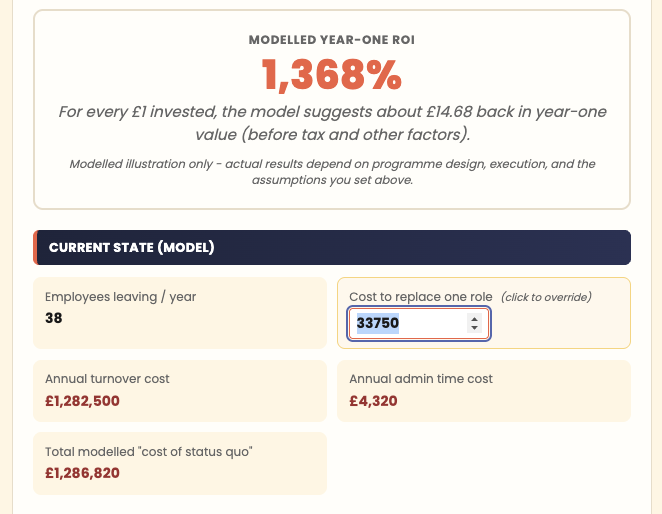
Click the image to run the model on your numbers.
How to baseline your current state
Before you can measure ROI, you need your starting point
Step 1: Gather your current data (week 1)
You need:
• Current turnover rate (last 12 months)
• Average cost per hire (recruitment + onboarding)
• Current engagement scores (eNPS, pulse survey results)
• Time spent on gifting admin (track for one month)
• Current gifting spend (all-in costs)
Where to find this:
• Turnover: HRIS system or payroll data
• Cost per hire: Finance or recruitment team
• Engagement: HR systems, survey tools
• Time tracking: Shadow yourself for a month
• Spend: Finance reports
Step 2: Calculate your current "cost of doing nothing" (week 2)
What is your current turnover costing you?
Example:
200 employees × 15% turnover = 30 leavers per year
30 × £25,000 replacement cost = £750,000 annual cost
That's your baseline problem size.
Step 3: Set realistic targets (week 2)
Conservative gifting programme impact:
• Turnover reduction: 2-3%
• Engagement lift: 3-5%
• Time savings: 80% (if moving from manual to automated)
Don't go wild with assumptions. Be conservative. You can always exceed expectations.
Step 4: Build your business case (week 3)
Create a simple one-pager:
• Current state (costs, metrics)
• Proposed programme (what you're asking for)
• Expected impact (conservative projections)
• ROI projection
• How you'll measure success
What to track (and how often)
You've got your programme. Now track it.
Monthly metrics:
• Program participation rate (% of employees receiving gifts)
• Redemption rate (% of gifts claimed/used)
• Delivery success rate
• Time spent on admin
Quarterly metrics:
• Employee engagement scores (pulse surveys)
• eNPS changes
• Recognition frequency (how often managers are gifting)
• Turnover rate
Annual metrics:
• Overall turnover rate
• Cost per hire
• Revenue per employee (productivity proxy)
• Program ROI (full calculation)
How to track:
Use a simple dashboard:
• Google Sheets or Excel for manual tracking
• Built-in analytics if using a platform (like Huggg)
• HRIS for turnover and engagement data
Set quarterly reviews:
• Week 13: Q1 review (are we on track?)
• Week 26: H1 review (adjust strategy if needed)
• Week 39: Q3 review (prep for budget renewal)
• Week 52: Annual review (full ROI calculation)
Common ROI calculation mistakes (and how to avoid them)
Mistake #1: Only counting gift cost
The problem: You tell leadership "we spent £20K on gifts" but forget to mention £5K in admin time saved.
The fix: Always calculate total cost AND total value. Show the full picture.
Mistake #2: Overly optimistic assumptions
The problem: "Our gifting programme will reduce turnover by 50%!" (Narrator: It won't.)
The fix: Use conservative estimates. Under-promise. If you say 3% and deliver 5%, you're a hero.
Mistake #3: Attributing everything to gifting
The problem: Engagement goes up 10% and you claim it's all because of gifting.
The fix: Be honest about attribution. Say "We estimate gifting contributed 20-30% of this improvement."
Mistake #4: Not tracking baseline
The problem: You launch a programme but have no before/after data.
The fix: Baseline FIRST. Track current state before implementing changes.
Mistake #5: Measuring too soon
The problem: You launch in January and measure ROI in February. No change yet, so you panic.
The fix: Give it time. Measure at 6 months and 12 months. Cultural change is slow.
Real-world example: Octopus Electric Vehicles
Company: Octopus Electric Vehicles (250 employees)
Challenge: Scaling recognition while maintaining culture and keeping admin low
Solution: Implemented peer-to-peer gifting programme with Huggg via Slack integration
The setup:
Octopus EV wanted to empower employees to recognise each other (with value limits), especially across different teams as they grew rapidly. With sustainability at their core, they needed a carbon-neutral solution with responsible sourcing.
They built a custom Slack integration with Huggg, so team members could send gifts directly to colleagues through Slack by filling out a simple form. Gift-givers associate one of the company's four core values with each gift, helping leadership track which behaviours are being rewarded.
The results:
Adoption: Huggg became their most utilised employee benefit across the business. After implementing the Slack integration, the majority of staff now use their quarterly budgets.
Investment: After seeing the impact on reinforcing core values, the company's investment in reward and recognition with Huggg increased 20-fold over 18 months.
Employee feedback (survey of 70 team members):
• 98.5% felt more empowered to recognise colleagues
• 95.5% felt more appreciated by peers
• 95.5% felt more appreciated by the company
• 71.6% felt more appreciated by their manager
• 70.1% felt more motivated at work
What this tells us:
Even without formal ROI tracking, the qualitative impact is clear. Nearly all employees felt more empowered and appreciated. Over 70% reported higher motivation.
If we apply conservative ROI assumptions to Octopus EV's numbers:
Estimated impact:
• 250 employees
• If 70% feel more motivated → engagement lift of ~5%
• If engagement reduces turnover by even 2-3% → savings of 5-8 employees retained
• At £27,000 replacement cost (average) → £135,000-£216,000 in retention savings
Against their gifting investment:
Even at £100 per employee (£25,000 total programme cost), the ROI would be 440-764%.
The takeaway: High adoption + measurable cultural impact = provable business value.
Presenting your ROI to leadership
You've done the maths. Now sell it.
What your CFO cares about:
• Hard numbers (not "morale")
• Conservative assumptions (not pie-in-the-sky)
• Proof points (how will you track success?)
Your one-page summary should include:
1. The problem
"Our 18% turnover rate costs us £1.2M annually"
2. The solution
"Strategic gifting programme: £28K investment"
3. The impact
"Projected 4% turnover reduction = £270K savings"
4. The ROI
"876% ROI. £9.76 return for every £1 invested"
5. The proof
"We'll track turnover, engagement, and admin time quarterly"
How to handle objections:
Objection: "We can't afford it"
Response: "We can't afford NOT to. We're currently losing £1.2M per year to turnover. This is a £28K solution to a £1M+ problem."
Objection: "Gifts won't fix culture"
Response: "You're right. Gifts alone won't fix culture. But strategic recognition - including gifting - is one lever. Research shows it reduces turnover by 12-15%. We're being conservative and projecting 4%."
Objection: "Can't we just do it manually?"
Response: "We are. And it's costing us 144 hours per year in admin time - that's £4,320. Plus higher error rates and lower satisfaction. Automation pays for itself in time savings alone."
FAQ: Corporate gifting ROI
How do you calculate ROI on employee gifts?
Calculate total value (time savings + retention savings + productivity gains + revenue impact) minus total cost (gift spend + platform fees + admin time), divided by total cost. Multiply by 100 for percentage ROI.
What is a good ROI for a corporate gifting programme?
There’s no single magic number - it depends on your headcount, turnover rate, and assumptions. Treat percentage ROI figures as conversation starters, not guarantees. Show leadership a range (conservative vs realistic) and what you’ll track to prove it. Our ROI calculator lets you stress-test your own numbers rather than rely on generic multiples.
How long does it take to see ROI from corporate gifting?
Programme metrics like participation and redemption are visible immediately. Engagement and retention move slowly, and we're not aware of published research that sets a reliable timeframe. Review engagement quarterly and hold the full ROI assessment until you have at least 12 months against a pre-launch baseline.
Can you measure ROI on client gifts?
Yes, though it's harder to attribute than employee gifting. Track client retention and referral rates before and after, and compare gifted accounts against a control group. Convert any retention gain to gross margin rather than contract value before you calculate a return, because the two give very different answers.
What metrics should I track for gifting programme ROI?
Monthly: Program participation, redemption rates, admin time
Quarterly: Engagement scores, eNPS, turnover rate
Annually: Full ROI calculation, cost per hire, revenue per employee
How do I prove corporate gifting works to my CFO?
Use conservative, data-backed projections. Focus on turnover reduction (highly measurable, significant cost impact). Present a one-page business case with clear before/after metrics and quarterly tracking plan.
What's the biggest ROI driver in corporate gifting?
Employee retention, because it's the most measurable and the replacement costs are the largest single number in the model. How much you save depends entirely on your own turnover rate and replacement cost, so run your own figures rather than applying a multiple. The 6 to 9 months of salary often quoted for replacement cost is a rule of thumb, not a measured figure for your business.
The bottom line
Corporate gifting isn't about "nice-to-have" anymore. It's about measurable business impact.
When you:
• Track the right metrics
• Calculate total cost AND total value
• Present conservative projections
• Prove results quarterly
You turn gifting from "HR fluff" into strategic investment. Your CFO will stop seeing gifts as a cost centre. They'll start seeing them as a retention lever with a number attached. And your budget? It'll not only survive the next finance review - it'll grow.
Ready to build your business case?
Calculate your modelled ROI → - the calculator runs the full framework above in about three minutes, so you walk into the meeting with numbers, not hunches.
Once you’ve got your figures, explore Huggg’s platform to see how we help companies send better gifts, faster. Or book a call to pressure-test the assumptions behind your numbers.
About Huggg
Huggg is a business gifting platform designed for mid-market companies. We help you measure, optimise, and prove the ROI of your gifting programmes - with built-in reports, time-saving tools, and gift with choice that drives higher satisfaction.
Trusted by over 2,000 UK companies including GoCardless, Octopus Energy, and Starbucks.
Last updated: 29 April 2026