Retail and hospitality has a recognition problem: 43% of its workers aren't motivated
September 1, 2026 · Culture, Guides
43% of retail and hospitality workers feel demotivated, against 24% of everyone else we surveyed. New Huggg research on where the recognition gap is felt hardest, and why.
Last month we asked 500 UK workers how their manager recognises them. Here's one of our findings: the recognition gap is felt a lot more strongly by one part of the workforce.
What our survey of 500 UK workers found
- 43% of retail and hospitality workers feel demotivated, against 24% of everyone else we surveyed
- They're also recognised less consistently than the rest of the workforce: 31% are recognised rarely or never, versus 20%
- But surprisingly, they're no more likely to be job-hunting than anyone else
- Retail and hospitality respondents numbered 74, compared against all 426 other respondents
Our survey of 500 UK workers had one clear headline: recognition is a consistency problem, rather than a budget problem. How often it happens, and whether it's genuine, matters a whole lot more than what you spend.
Figures, right? A luxury bouquet of red roses from your other half after a mysteriously late night doesn't feel… great. Them picking you up a bag of Maltesers whenever they pop to the shops, as they know they're your fave, that's the one that means something.
So employers aren't always amazing at consistent recognition. But is it worse in some industries than others?
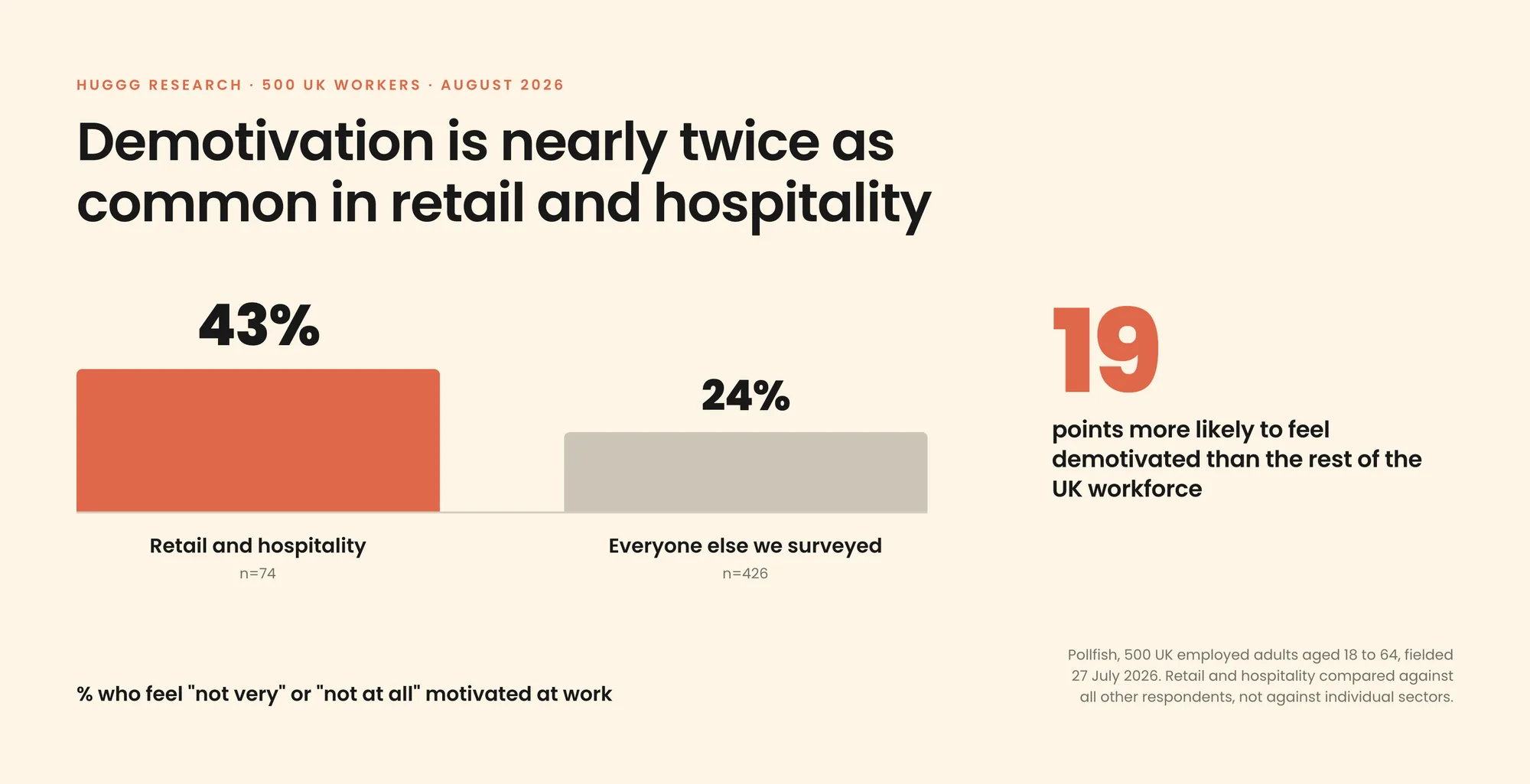
The answer is retail and hospitality, and the gap is big. 43% of the retail and hospitality workers we surveyed said they feel "not very" or "not at all" motivated at work. Across everyone else we surveyed, that figure is a lot lower - just 24%.
Who we're actually talking about
It's worth pausing on what this workforce looks like, because it explains a lot.
These are people on shifts. Maybe double shifts. Gruelling, unrelenting, why-are-the-general-public-like-this shifts. They're on the shop floor, behind the bar, in the kitchen, spread across sites, often part-time, frequently working when their manager isn't. There's no all-hands to receive praise and adulation in. There's no company email, or Slack channel shout-outs.
So the mechanics that most recognition schemes rely on - where everyone is reachable, in the same place, at roughly the same time - just don't work in this setting.
The gap is about how often people are recognised
Retail and hospitality workers are recognised less consistently than the rest of the workforce. 31% told us they're recognised rarely or never, against 20% of everybody else. For a lot of them, recognition just isn't a regular thing. And that's a big problem. These are the people who are face to face with your customers all day, so how motivated they feel is what your customers actually experience.
So both gaps land on the same group. Given that the whole survey showed motivation tracking recognition frequency almost perfectly (8% demotivated when it's weekly, rising to 95% when it never happens), it wouldn't be a huuuge stretch to assume they're related.
We won't overdo it though: this isn't proof. But the pattern is consistent - and it's one we'd probably all expect.
The part we didn't expect
Here's where it gets more interesting.
If a workforce is significantly more demotivated than everyone else, you'd expect them to be a looot more likely to be thinking of leaving. You hate your job, you quit - right? But that's not what the data says here.
64% of retail and hospitality workers had thought about leaving or were actively looking, against 58% of everyone else. That's a small enough difference that we can't call it real.
So they're not more likely to be on their way out. They're staying, and staying demotivated.
We can't tell you why from this survey. Maybe there's less worth moving for, when the job down the road sort of looks near-identical to the job you've got. It might be that in a sector with high churn anyway, the people who were going to leave have already gone, and what's left is the group who'll stay whatever happens.
Either way, it's the opposite of reassuring. "They're not quitting" is not the same as "they're fine", and that's something worth considering.
One thing we're not going to tell you
We're not publishing a league table. We surveyed enough people across four industries to talk about them at all (retail and hospitality, education, healthcare and social care, and financial and professional services), but when we tested those industries against each other, most of the gaps sat inside the margin of error. Ranking them would be inventing a precision we don't have.
What does hold up is retail and hospitality against the whole of the rest of the workforce. So that's the comparison we've stuck to, and the only one we'd stand behind.
What actually changes it
If the problem is that recognition doesn't happen often enough, then a better rewards catalogue isn't the answer. Neither is a bigger budget. Our own data already showed spending more doesn't really move the numbers.
What does matter is recognition that is built around how the workforce actually works. That means it can't depend on everyone being in a room together. It has to be something a shift manager can do in the moment, on the floor, without escalating to head office and waiting three days for a sign-off. And it can't assume you have a home address for someone who's never had a desk.
That's a harder thing to build than a voucher scheme. It's also the only version that reaches the people this data says are missing out.
How Huggg can help
Huggg is built for teams that aren't all in one place. Recognition Budgets mean a manager can send something the moment it's earned, without an approval chain. Gift with Choice means you send a link and the recipient picks what they actually want, so you don't need anyone's address to start. Printed cards with a QR code mean a manager can hand someone a physical "thanks for staying late" on the floor, and they choose their own gift from it.
And the core platform is free: you pay for the gift, that's it.
If recognition in your business is patchy because your teams are spread out, that's a problem we're pretty good at solving.
Methodology
Survey of 500 UK employed adults aged 18 to 64, conducted via Pollfish and fielded on 27 July 2026. Respondents were 50% male, 50% female, and 79% in full-time work. Retail and hospitality respondents numbered 74; sector figures are compared against all 426 other respondents rather than against other individual sectors, because the individual sector samples are too small to separate reliably. Differences reported as findings are statistically significant at the 95% level. Figures reflect self-reported motivation, flight risk, and recognition from a direct line manager.