Empty recognition: what 500 UK workers told us about being thanked at work
August 18, 2026 · Culture, Guides
We asked 500 UK workers how their manager recognises them. How often it happens, and whether it's genuine, mattered far more than what was spent on it.
We surveyed 500 UK workers about being recognised by their manager. The pattern was clear: how often it happens, and whether it's genuine, matters a huge amount more than the size of the budget behind it.
What we found (survey of 500 UK workers, July 2026)
- Recognition frequency lines up with motivation almost perfectly: 8% of people recognised weekly feel demotivated, rising to 95% of those never recognised
- 54% of UK workers say they aren't recognised consistently
- Recognition that comes with nothing at all leaves workers demotivated 73% of the time. When it comes with something tangible, that's 21%: the lowest figure in the study
- Genuine, consistent recognition is what moves the numbers, and 16% of workers say theirs "comes with nothing at all"
Ask most companies how they recognise their people and you'll either hear "Amazon gift cards", get a ludicrously complicated description of their points-based recognition programme, or, in the worst cases, receive a blank look.
But what would employees on the receiving end say? We surveyed 500 UK workers about how their manager recognises them, how motivated they feel, and whether they've thought about leaving. You might find the results surprising - we kinda did.
The biggest problem is recognition not happening
Let's start with how often recognition happens. 95% of people who say they're never recognised are demotivated. That drops to 70% of people recognised rarely, and again to 37% of those recognised occasionally. But when you look at employees who are recognised at least weekly? Only 8% are demotivated.
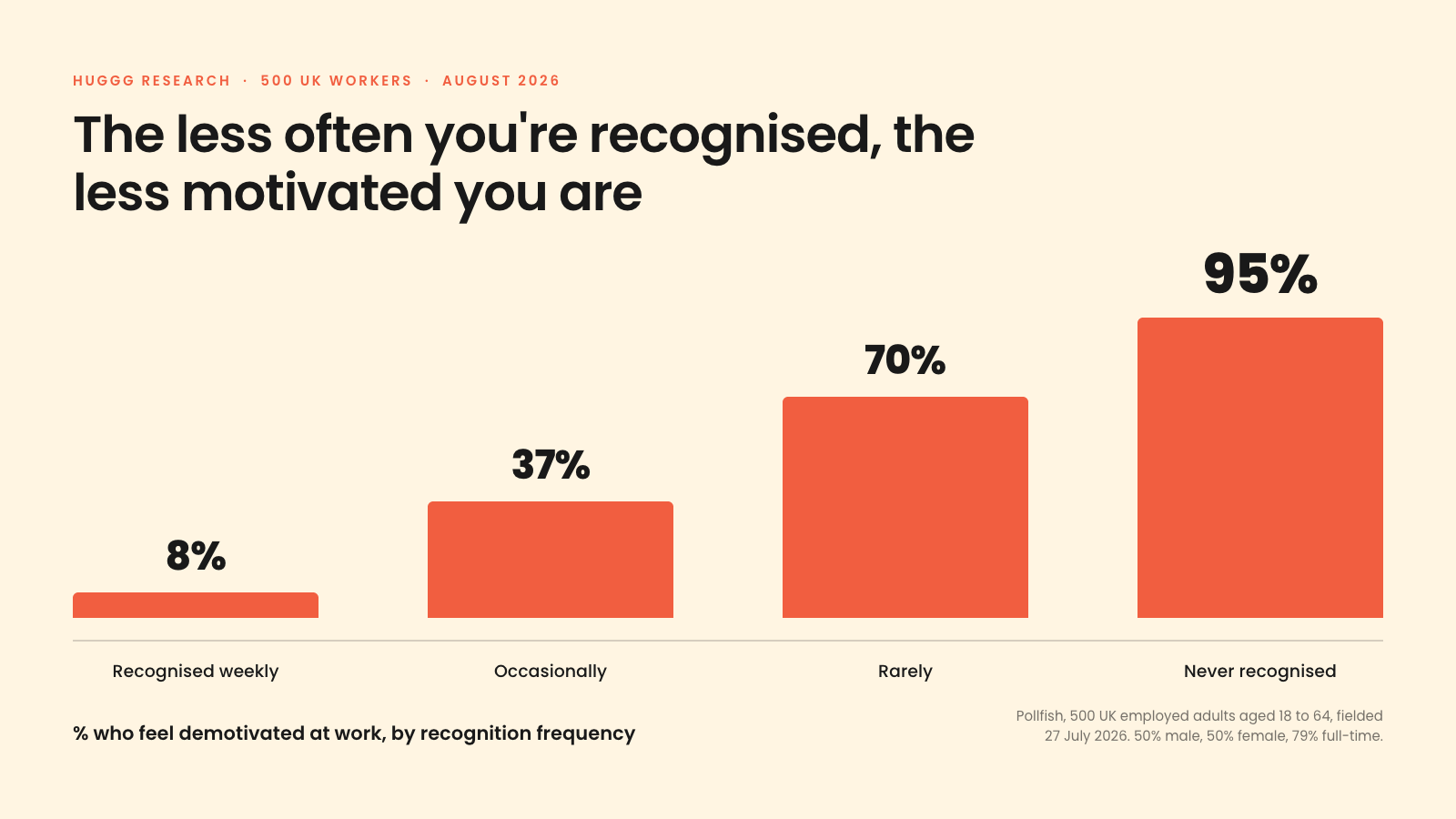 Demotivation by how often a manager recognises you. Huggg, 500 UK workers, July 2026.
That's a dramatic jump. And it's worth taking note of, because over half of UK workers report that they're not recognised consistently. For the majority, hearing a "thanks!" or a "you nailed this!" isn't a regular occurrence.
That's a problem, but not necessarily a surprise. Shocker: people who don't feel appreciated are less motivated at work. What is a surprise is the next finding...
Recognition with nothing attached is the real problem
We asked people what form their recognition takes. 16% said it "doesn't come with anything at all". Not a reward, not even a verbal thank-you. Recognition that's technically happening on paper, but landing as nothing. Of that group, 73% were demotivated.
A genuine verbal thank-you brings that down to 26%. And employees whose recognition came with something tangible (a physical gift, a gift card, points) sat at 21%: the lowest demotivation we recorded for any form of recognition in the whole study. Flight risk followed the same shape, at 55% for the tangible group against 58% for the ones getting words alone.
Fifty-two points separate "nothing" from "something real". That's the finding. We're not going to build a big claim on the last five points, because on a group this size that gap is too small to call. But the bottom of the scale is recognition that's genuine and has something real behind it.
So the real gap was never "thank you" versus a reward. It's genuine recognition versus the hollow, box-ticking, logged-in-a-system-but-with-no-real-warmth-attached kind.
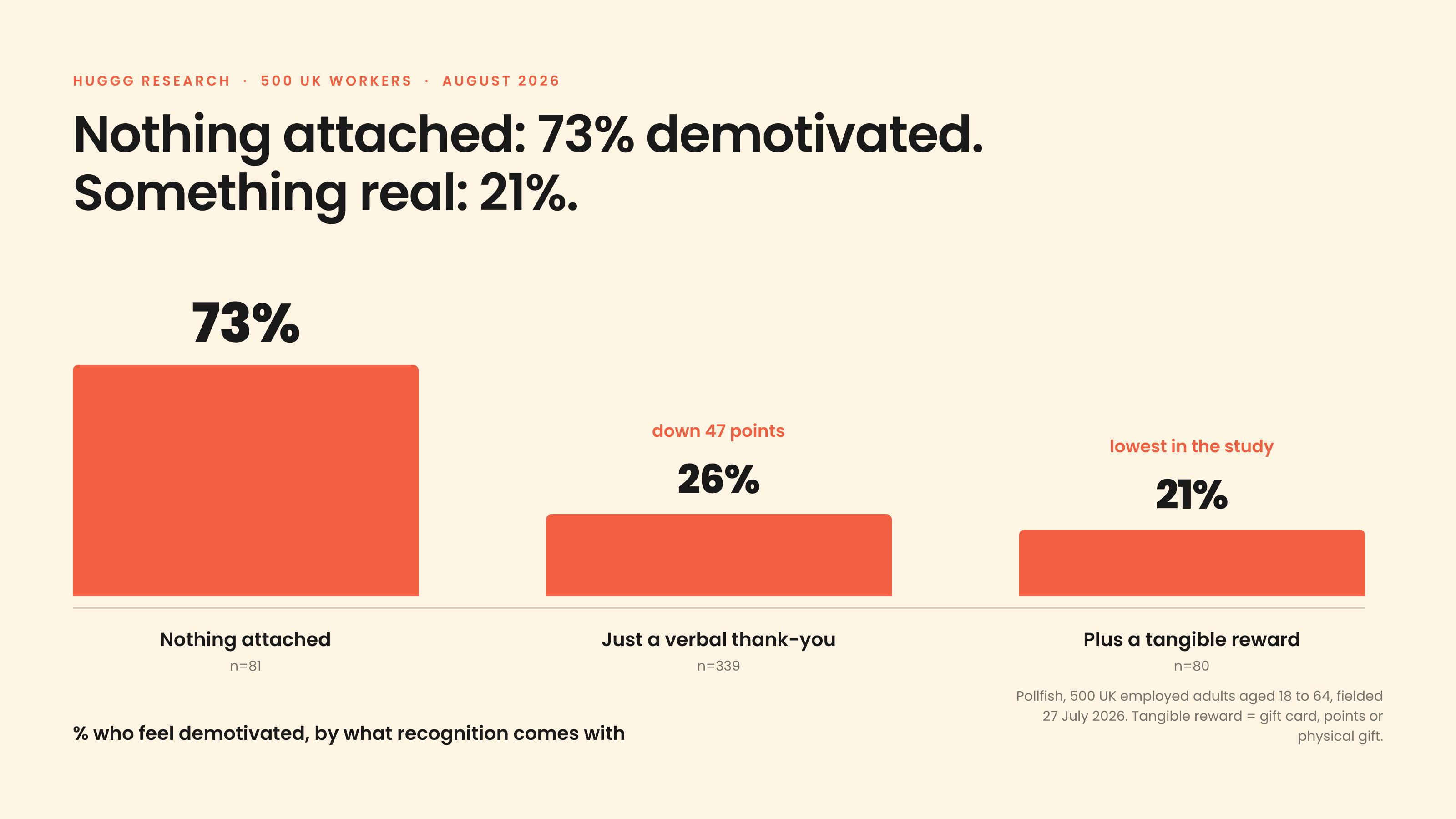 Demotivation by what the recognition comes with. Huggg, 500 UK workers, July 2026.
The relationship is what really matters
The single strongest signal in the whole survey wasn't about tangible rewards. It was the employee-manager relationship.
Workers who rated their relationship with their manager as "very good" were demotivated only 7% of the time, and 36% had thought about leaving.
As for employees who rated that relationship as "poor" or "very poor"? 88% said they were demotivated, and a concerningly substantial 84% were heading for the door. Recognition works when it comes from someone who means it. But it doesn't feel legit if it's delivered by a manager you don't have a good relationship with.
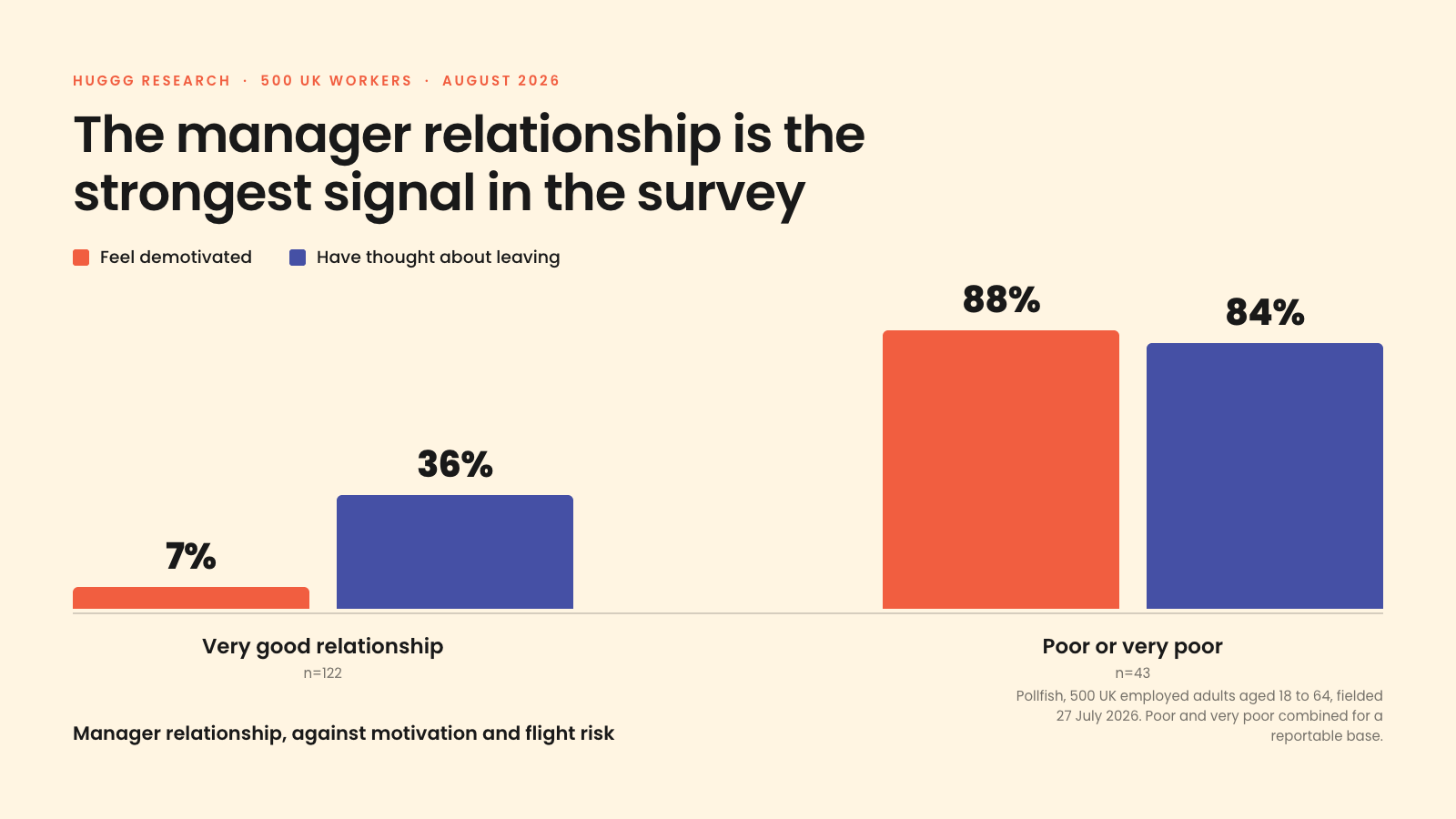 Motivation and flight risk by how workers rate their manager. Poor and very poor combined, n=43. Huggg, 500 UK workers, July 2026.
This isn't a 'young people' problem
It's worth pointing this out: there's a lot of chat about the changing attitudes of employees, with Gen Z often chastised for their approach to working life. But this isn't a factor here. The pattern held flat across age, gender and full-time versus part-time. This isn't tale of overly entitled Gen Zers who don't know how good they've got it, grumble grumble. It's how people respond to being seen at work. That's really all it is.
What this actually means
If recognition is a now-and-then thing, or feels hollow, then spending more won't save it. The fix isn't a bigger rewards catalogue. It's making genuine recognition happen consistently, from the manager who's actually there in the moment, who sees the work their people do, and who says so when it matters.
That's a harder problem to solve than picking a new rewards programme, or upping your gifting budget. But it's the one that moves the numbers.
Try our recognition scorecard
That's the question this research leaves you with, and it's harder to answer about your own team than it sounds. Our recognition scorecard takes a couple of minutes and shows you where the gaps are.
How Huggg can help
At Huggg, we make in-the-moment recognition easy. Recognition Budgets which let line managers send little appreciation gifts without waiting on an approval chain. Gift with Choice, so you send a gifitng link and they pick what they actually want, with no addresses needed up front. And the core platform is free: you only pay for the gifts you send.
Want to make recognition easier and more consistent? Talk to us.
Methodology
Survey of 500 UK employed adults aged 18 to 64, conducted via Pollfish and fielded on 27 July 2026. Respondents were 50% male, 50% female, and 79% in full-time work. Figures reflect self-reported motivation, flight risk, and recognition from a direct line manager.