The Christmas Gift Report: what 500 UK workers got, and what they actually chose
September 21, 2026 · Christmas, Guides
We surveyed 500 UK workers about last Christmas and pulled the redemption data from 477 companies. A third got nothing. Most of the rest called it generic. Here's what actually worked.
Most companies spend December guessing what their team actually wants. We got tired of guessing too, so we went and asked.
This is the Christmas Gift Report: 500 UK workers surveyed on what they got from their employer last Christmas and how it felt, set against the real claims data from the 477 companies in our Christmas 2025 data set. One dataset says what goes wrong. The other says what people do when someone hands them the choice.
They don't agree everywhere. We've left that in.
The quick answer: 31% of UK workers got nothing at all from their employer last Christmas. Of those who did get something, 42% called it appreciated but generic, against 34% who felt genuinely valued. The Christmas party is the most common gesture and the weakest one on its own. And when employers handed over the choice, 84% of recipients picked something outside the top 10, across 610 different products, which is the clearest sign in the data that nobody can guess this well.
A third of UK workers got nothing at all
Thirty-one per cent of the 500 people we surveyed received nothing from their employer last Christmas. No gift, no card, no party, no bonus.
That group didn't shrug it off. Half of them felt negatively about it.
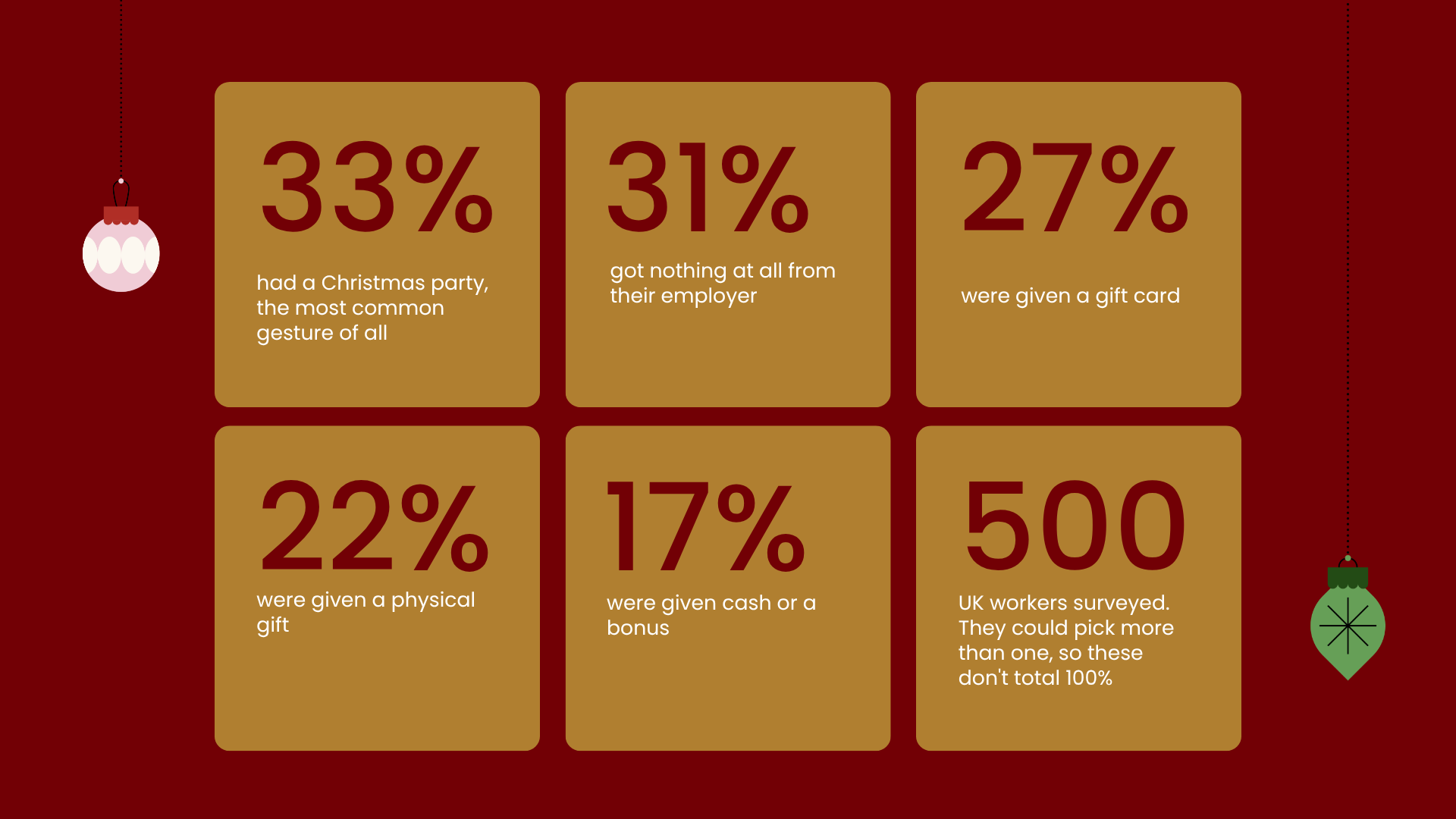
The gap isn't evenly spread, either. Getting nothing is flat across income, sitting between 29% and 31% from under £20k right up to £60k plus, so this isn't a low-pay story. Where it does split is elsewhere:
- 41% of over-45s got nothing, against 30% of 30 to 44 year olds
- 38% of part-time workers got nothing, against 28% of full-timers
- 35% of women got nothing, against 25% of men
Read that as a coverage gap rather than an accusation. Part-time and older workers are the people most likely to sit outside whatever the default list is, and defaults are usually built from a payroll export nobody has looked at properly since March.
Most of the gifts given felt generic
Of the 347 people who got something, 42% said it was appreciated but it felt generic. Only 34% said they felt genuinely valued.

Generic isn't the same as failed. Nobody is offended by a branded notebook. But it isn't the same as working either, and that's the expensive part: it's budget going out without gaining the goodwill.
Most Christmas gifting isn't bad. It just could be making more of an impact.
The Christmas party is the most common gesture, and on its own it's the weakest
A third of employers put on a Christmas party, making it the single most common thing UK companies do at Christmas. It also scores worse on feeling valued than any gift format in the survey: 29% felt genuinely valued, 45% said it felt generic.
Before anyone cancels the party, look at what's underneath that number.
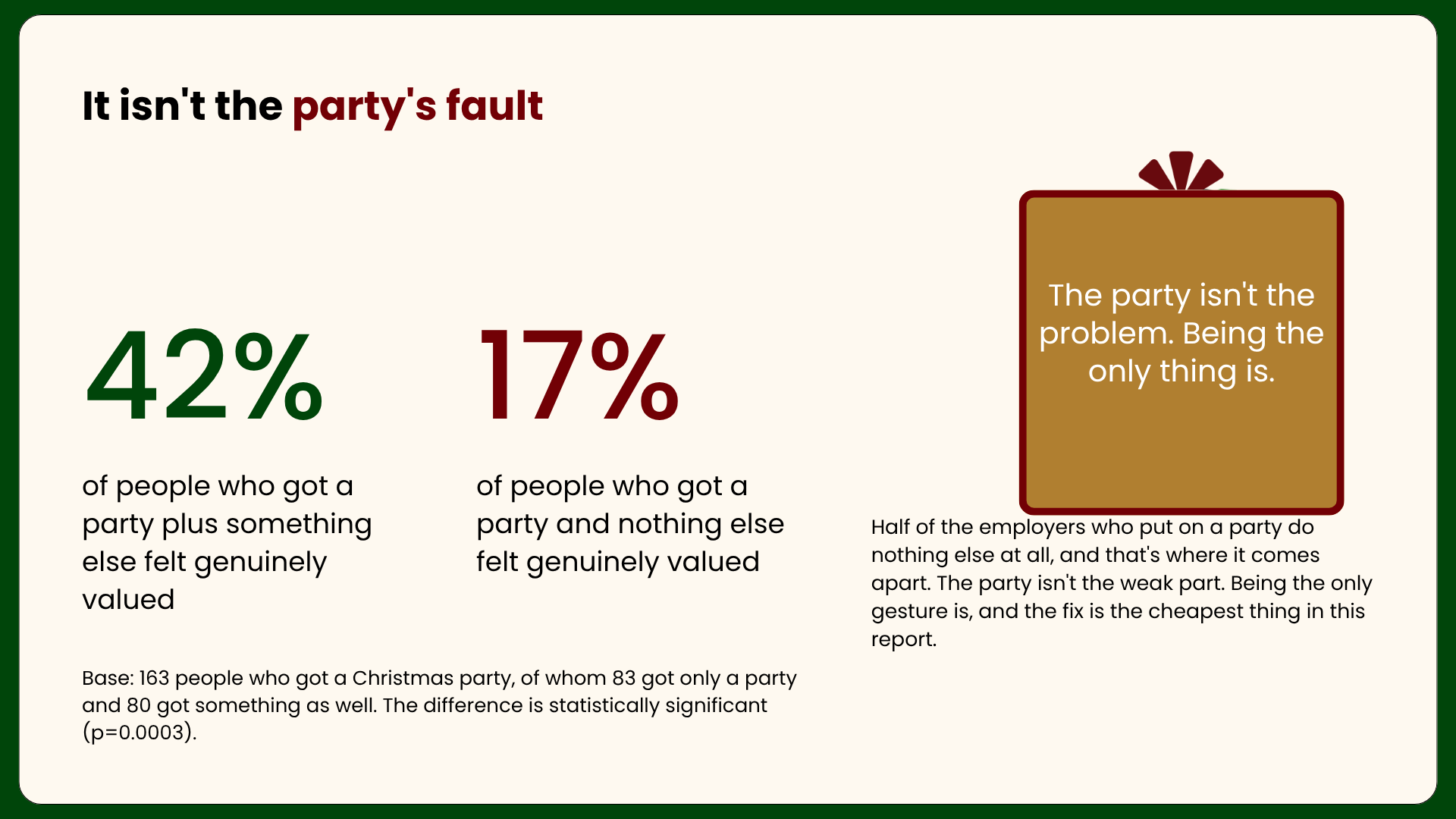
Of the 163 people who got a Christmas party, 83 got only the party. Those people scored 17% on feeling genuinely valued. The 80 who got a party plus something else scored 42%. That difference is statistically significant (p=0.0003).
So the party isn't the problem. Being the only thing is. Half of the employers who put on a party do nothing else at all, and that's where it comes apart.
It's also the cheapest fix in this report. You don't need a bigger party. You need the party plus something small that belongs to the person.
Cash does score well on sentiment. Here's the catch.
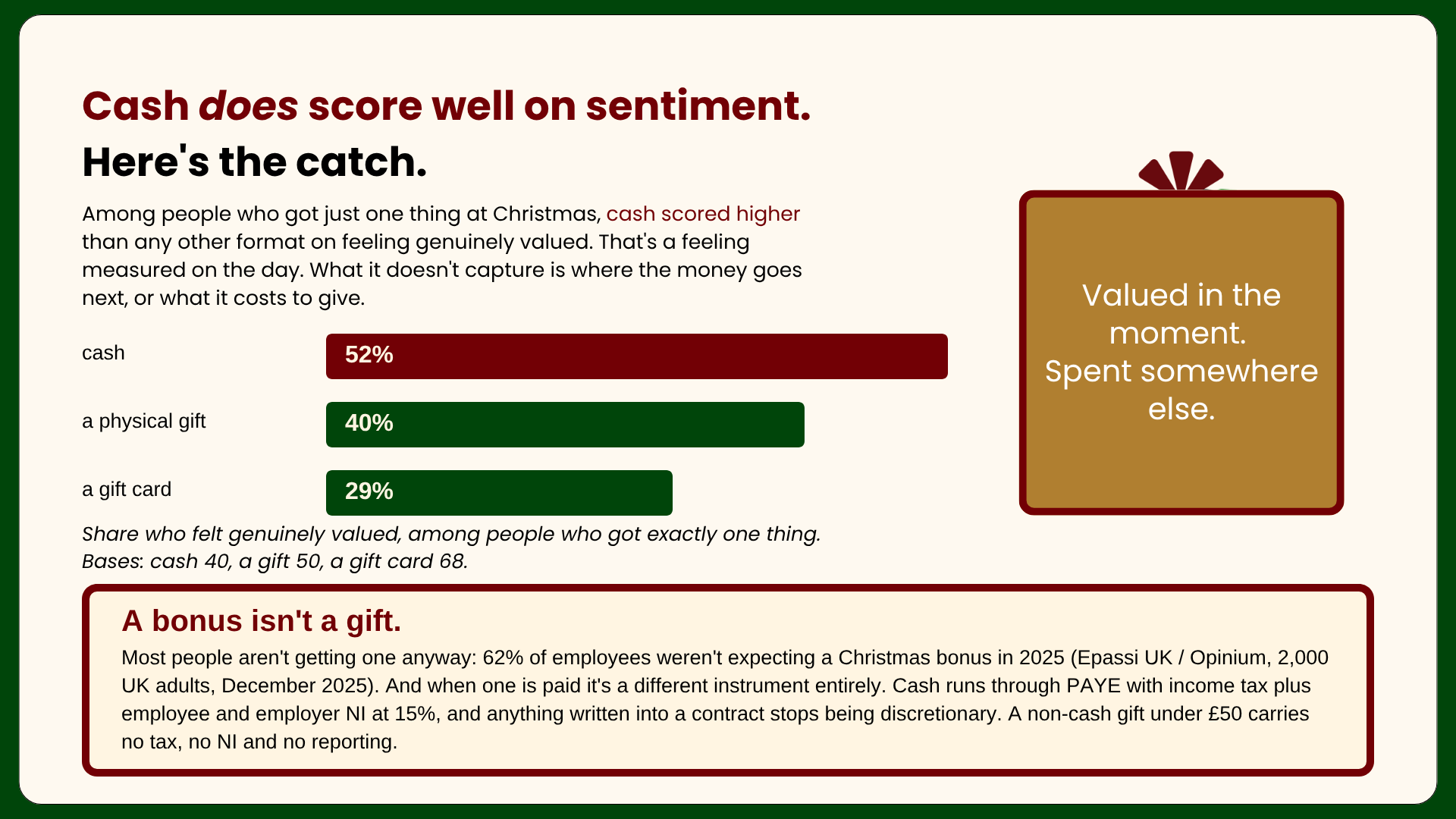
Among people who got exactly one thing at Christmas, cash scored higher than any other format on feeling genuinely valued: 52%, against 40% for a physical gift and 29% for a gift card.
But look at where the cash goes.
Only 45% of people who got cash spent it on a treat for themselves. Twenty-seven per cent put it towards bills or something practical, and another 23% spent it on someone else. So less than half of it reached the person it was meant for. It feels valued in the moment, and then most of it goes somewhere else.
There's a second problem, and it's a tax one. Cash is the single thing HMRC's £50 exemption specifically excludes, so a Christmas bonus runs through payroll and gets taxed like salary. It costs you more to give than it's worth to receive.
And when economists tested gifts against cash directly in a workplace field experiment, workers said in advance that they'd rather have the money. The ones who got a gift instead worked measurably harder. (Kube, Maréchal and Puppe, The Currency of Reciprocity: Gift Exchange in the Workplace, American Economic Review 102(4), 2012.)
Cash wins the survey question. It loses on where the money lands, on tax, and on what it actually does.
What happens when you let people choose
That's the survey half. Now the behaviour.
Across the 477 companies in this data set, 79% of gifts let the recipient choose their own. Only 21% were fixed gifts picked by the sender. Choice isn't a marginal trend in this data, it's the default.
And people genuinely use it. Across almost 9,000 choose-your-own claims, the 10 most popular items accounted for just 16% of picks.
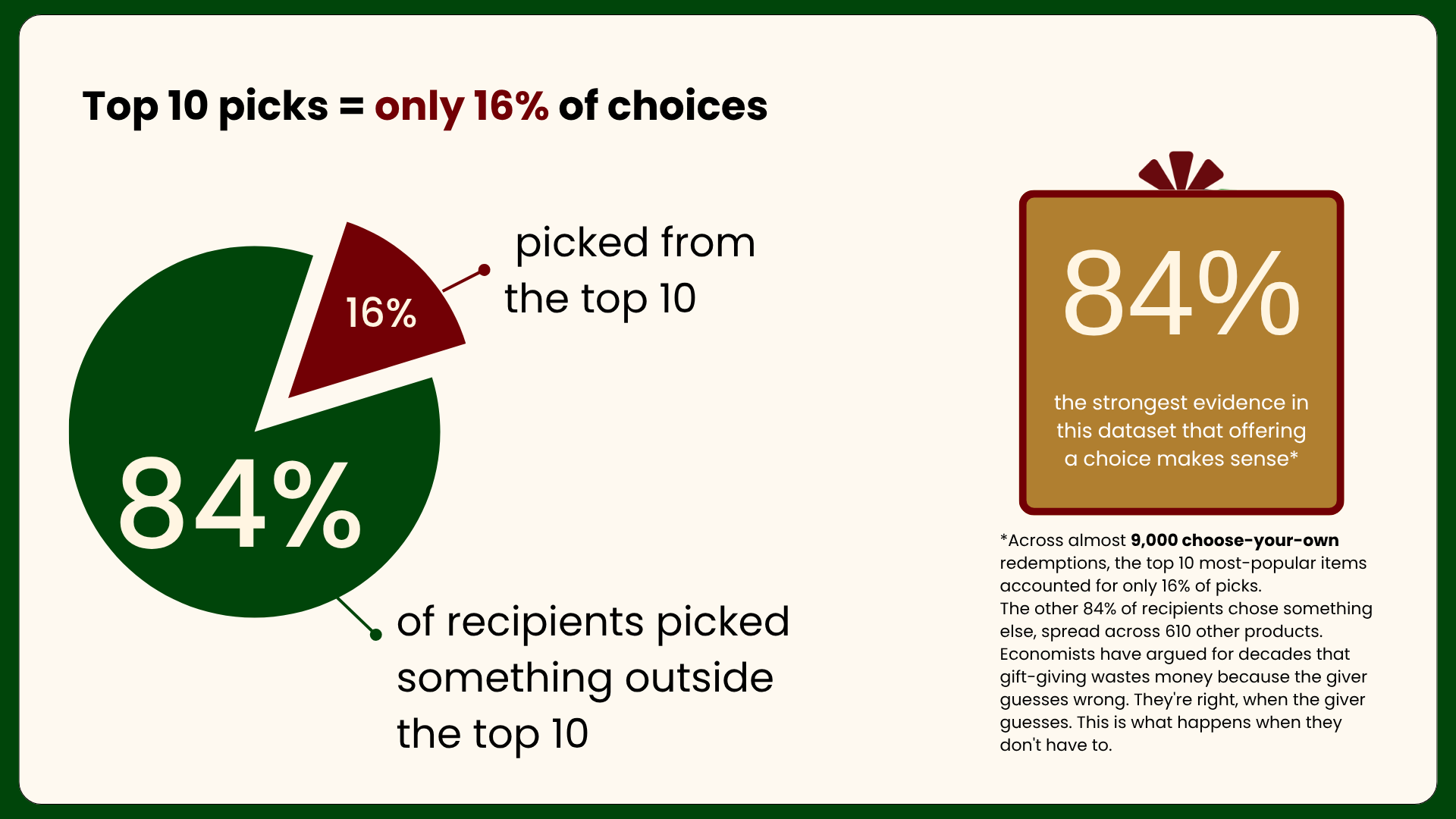
The other 84% went somewhere else entirely, spread across 610 different products.
That's the whole argument for choice in one number, and it isn't an emotional one. Economists have argued for decades that gift-giving destroys value because the giver guesses wrong. They're right, when the giver guesses. No curated fixed gift, however carefully chosen, covers a 610-product long tail. You cannot buy your way to that hit rate. You can only hand it over.
What people actually picked
When recipients had total freedom, the top two picks were both wine. Third was a wellness lamp, not chocolate.

There are two reads on this. The obvious one: people pick treats they wouldn't normally buy themselves, premium wine, genuinely good olive oil, branded water bottles.
The more useful one: when chocolate is sitting right there and freely available, people don't automatically pick more chocolate. They pick wellness and decent kitchen kit. An air fryer came ninth.
The brands that came out on top
Across all gift types, the leaderboard is food-first. Procurement partners are excluded, because their claims sit under the partner rather than the brand people actually picked.

Hotel Chocolat tops it, helped by a lot of senders defaulting to a name everyone recognises for a fixed gift. Fair enough, you can't really go wrong. But Hotel Chocolat also shows up in the free-choice top 10, so the appeal is real rather than just a default.
What breaks the food pattern is YETI at four and Le Creuset at six. Both premium lifestyle brands, both firmly in the "that's a keeper" category. The takeaway for 2026 isn't obscurity, it's quality: recognisable brands people would be pleased to own.
Are Christmas gifts for employees tax deductible in the UK?
Yes, in most cases. Provided each gift costs £50 or less per employee, isn't cash, and isn't a reward for performance, it qualifies as a trivial benefit under HMRC rules. That means no income tax and no national insurance for either side, and nothing to report on a P11D.

Most companies don't realise how much room they have. Four conditions have to hold:
- The gift costs £50 or less per person, including VAT
- It isn't cash or a cash voucher
- It isn't a reward for work, performance or hitting a target
- It isn't written into the employee's contract
There's no annual cap on the number of trivial benefits, so a gift at Christmas, another on a work anniversary and another for a birthday can each sit inside the £50 rule on their own. Directors of close companies are the exception, with a £300 annual cap.
Client gifts work differently: HMRC generally treats them as entertaining and not deductible, unless the gift carries a conspicuous advert for your business, isn't food, drink, tobacco or a voucher, and costs under £50 per person per year.
For a marker on what to actually spend: when employers gave their team a genuine choice in 2025, the average gift came to £37.56. Comfortably inside the limit, with room to spare.
This isn't tax advice. Check your own situation with your accountant.
Most Christmas gifting happens in December, and that's fine
If you've been told you need to have Christmas wrapped up by October, the data disagrees.

Two-thirds of all Christmas purchases happened in December alone. Add November and you're at 97%. October, supposedly the early month, accounted for 1%.
That isn't lateness. It's just when budget lands. December only becomes a problem when what you're sending depends on stock, branding slots and delivery addresses, because those are the things that run out. A gift people claim for themselves has none of them: no stock ceiling, no address list to chase, no courier cut-off. Set up in November if you want the calm. December still works if you don't. That's sort of the beauty of Huggg.
Three things to take into 2026
Give people a choice. Not because choice feels nicer, but because a curated fixed gift can't cover a 610-product long tail. The 84% figure is the evidence.
Known names, real choice. Names people know top the list: Hotel Chocolat, Virgin Wines, YETI, Le Creuset. But the top 10 was only 16% of picks. The range is doing the work.
December still works. 67% of purchases happen then. That's only a problem if your gift needs stock and an address. A claim link needs neither.
Don't let the party be the only thing. Seventeen per cent versus 42% is the biggest swing in the survey, and closing it costs less than the party did.
Methodology, and the full report
Two datasets, reported separately.
Survey: Pollfish, 500 UK workers, fielded August 2026, unweighted. Base sizes are stated alongside each finding. The smallest cuts rest on 40 to 83 people and are marked indicative. Industry cuts are excluded because the cells are too small to compare one sector against another.
Claims: every Christmas gift claimed through Huggg between 1 November and 31 December 2025. 477 unique sending companies, anonymised throughout, 110 brands, 673 products.
One thing worth stating plainly: the tables are cut three ways, deliberately. The headline totals (477 companies, 110 brands, 673 products) include every Christmas claim. The most-chosen products and the free-choice analysis (the 84%, the top 10, the £37.56 average) exclude single-employer campaigns, including one that ran October to December but wasn't Christmas activity, because a single employer's bulk send would otherwise dominate a ranking. The brand leaderboard includes all campaigns but excludes procurement partners, whose claims sit under the partner rather than the brand people actually chose. Recompute from one and you won't land on another. That is deliberate, not an error.
The full report runs to 46 pages, with every chart, the complete top 18, and the full tax and VAT section. It's free, and there's no form.
Download the full Christmas Gift Report (PDF)
Where Huggg fits
Huggg is a UK corporate gifting platform built around exactly the finding in this report. You set a budget, send a link over email, Slack or Teams, and the recipient picks what they want from more than 10,000 options across 700+ brands. No sign-up for them, no points, no expiry admin, no address spreadsheet for you.
Huggg is free to use and you only pay for the gifts you send, with P11D-ready reporting for the £50 question. It's used by over 2,000 UK businesses, and it's where the claims half of this report comes from.
If you want to see how Gift with Choice works before the December rush lands, talk to us. Whenever you're reading this, there's still time.